Feel proud of JGO students
Share
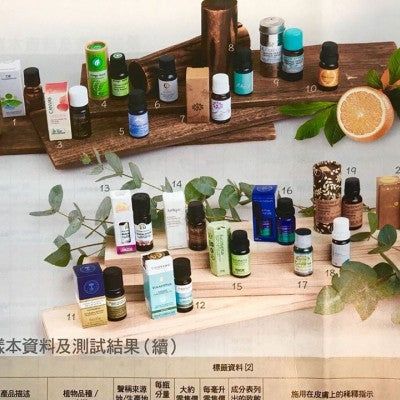
On Wednesday, the Consumer Council released their report on testing essential oils, titled "A large test of 30 popular aromatherapy oils, all of which found different skin allergens."
I couldn't help but frown when I saw the title, but when I looked closely at the content, I unconsciously raised the corners of my mouth.
Thanks to the Consumer Council for doing this test. In the past few days of class, my classmates and I discussed this test together and found that the students were very objective and used the knowledge they learned in class to understand this report.
We're discussing what we can learn from this test:
> Sweet Orange Essential Oil
1) The monoterpenes of sweet orange essential oil can reach 90%, "and limonene accounts for about 70% on average, but the sweet orange essential oil sold in one store only contains 28.9% limonene." This is what we need to pay attention to.
2) "Animal experiments have shown that only oxidized limonene can cause contact allergies . Limonene itself does not cause contact allergies, so it must be stored carefully to reduce the production of limonene oxidation."
(Additional note: Most of the sweet orange contains d-limonene, which is easily oxidized and turns into para-cymene after storage. Para-cymene is a transitional component and will become para-cymene after storage. into carpetol or thymol, which will irritate the skin more)
3) "Limonene has industrial uses",
(Supplement: Lemon peel can be squeezed and extracted in five stages, the first stage is usually used for aromatherapy, and the fifth stage is mostly used for industrial purposes)
> Eucalyptus globulus essential oil (Eucalyptus globulus)
1) The royal ingredient in eucalyptus essential oil (about 70% oxides) is not in the detection range
2) Monoterpenes account for about 15% in eucalyptus essential oil, and only about 4.78% of limonene in the report
3) After checking multiple data on the ingredients of Eucalyptus globulus, there is no indication that it contains citral. Among them, there is a product originating in Thailand that contains 0.775% citral.
> Lavandula angustifolia
1) Among the 10 samples, the botanical name of one sample is Lavandula angustifolia x latifolia , which is striking lavender and not true lavender
2) It should be noted that toluene and methanol are controversial because they are generally used as solvents for extraction. Therefore, when essential oils contain such substances, there is reason to doubt the extraction method and whether it is natural. However, according to phytochemia's research, toluene naturally exists in small amounts in plants. According to research, the content of essential oils such as frankincense and cedarwood is 0.01-0.11%, but the toluene content of essential oils tested by the Consumer Council is 52-52%. 261 mg/kg, or 0.0052%-0.026%, while the amount of methanol is 17-690 mg/kg, or 0.0017%-0.069%. It is an acceptable amount and safe.
Thanks again to the Consumer Council for their testing, which has aroused the public’s understanding of the application of essential oils. Everyone knows that in order to use them safely, essential oils must be dilute before use and cannot be consumed indiscriminately.
Learn more about the presence of toluene in plants https://www.phytochemia.com/en/2017/11/01/toluene-in-essential-oils/